

Who this page is for
You own a lot, or you are buying one, and you want to build the home you will live in. You may be hiring a licensed builder for the whole job, or you may be in the trades and planning to run it yourself. If the plan is to sell the finished home, building to sell is the page you want.
Either way the lender's questions are the same: what will it cost, who is building it, what will it be worth when it is done, and can you carry the mortgage afterwards. Lendrite arranges the construction mortgage with lenders who do this kind of build, presents the budget and the builder package the way the lender's underwriter, the person who decides, expects to read them, and stays on through each draw (a stage payment released as the build reaches a milestone).
Sunny Bal holds a BC residential builder licence, so your budget is read by someone who has priced a build, not only placed one. Book a 20-minute call →
Owner-builder or licensed builder
BC's homeowner protection rules give you two routes. A licensed residential builder is registered with BC Housing and enrols the home in third-party new-home warranty insurance. An owner-builder builds a home for their own use under an authorization from BC Housing.
Lenders treat the two routes differently. With a licensed builder and a fixed-price contract, the lender knows what the build costs and who is responsible for finishing it. With an owner-builder, the lender looks at your relevant experience as closely as the budget: trade experience or a project manager, quotes behind every line, and a larger cushion for the unexpected. Some lenders do not take owner-builders at all, so the route you choose narrows the list before we start.
The rules are BC Housing's and they change; check the current requirements before you decide. We will tell you which lenders fit each route.
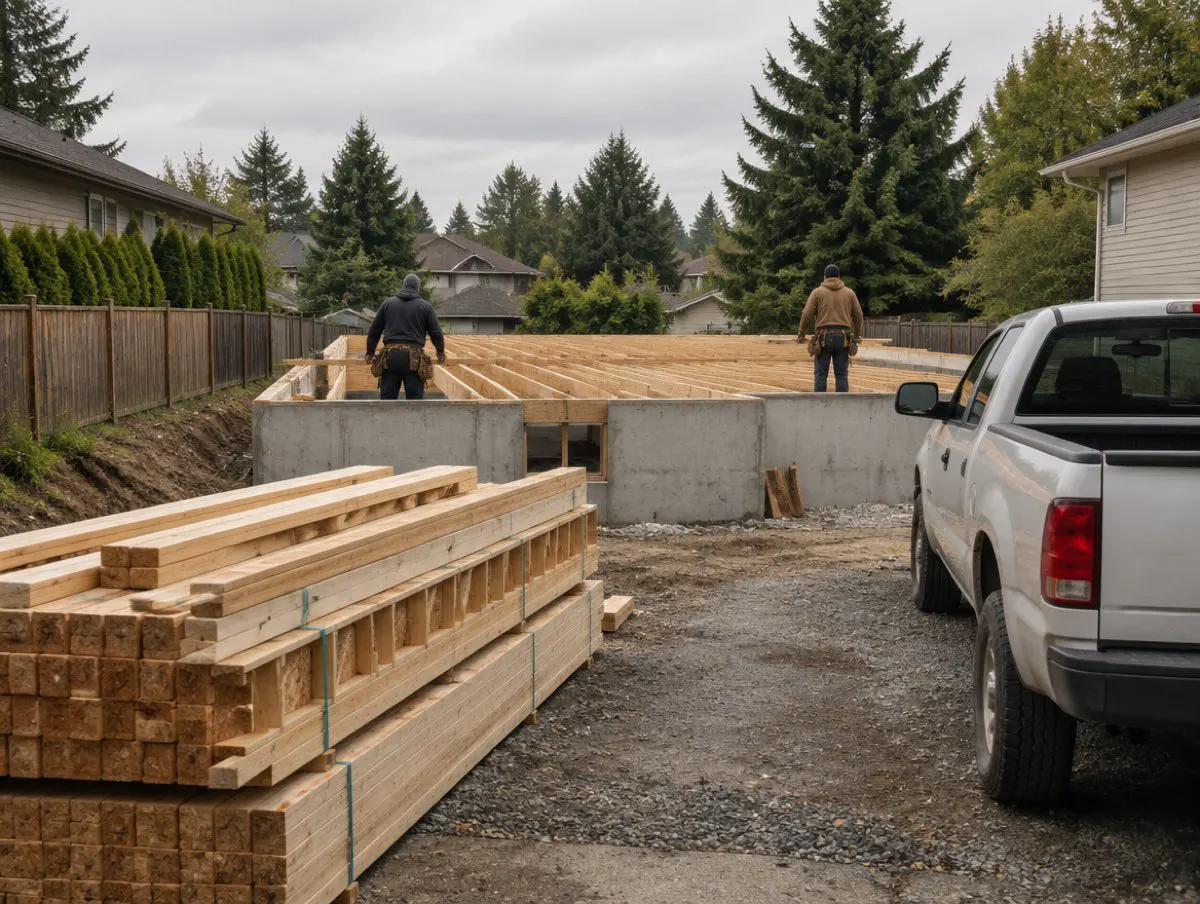
The budget on the lender's template
Every lender has its own budget form, and it is the first thing the underwriter reads. It breaks the build into lines: the land, the soft costs such as design, engineering, permits, survey and insurance, then each stage of construction from excavation to finishing, a contingency line, and the interest reserve.
What matters is what sits behind each line. A quote from a trade, a contract price, a permit fee schedule. Lines marked as allowances, with no quote behind them, are where draws stall later. We take your builder's numbers, or your own quotes, and put them on the lender's form so the stages match the draw schedule and the totals match the contract.
If the lot already has a mortgage, or you are buying the lot and building in one application, the land line and its financing are set up before the first draw.
Draws and inspections, stage by stage
The same loop repeats until the occupancy permit is in.
- 1
Build the stage
Your builder or your trades complete a stage: foundation, framing to lock-up (roof, windows and doors in), mechanical and drywall, finishing. Who pays the invoices before the draw, you or the builder, is set in the contract.
- 2
Request the draw
We send the lender the draw request with the invoices and the paperwork for that stage. There is usually a fee for each inspection, and it is in the budget from the start.
- 3
Inspection
The lender sends an appraiser or inspector to the site to confirm how much of the build is complete. The draw is sized to the work done, not to the invoices alone.
- 4
Advance, less the holdback
The lender releases the money for that stage, keeping back the share the Builders Lien Act requires until the window for trades to register a lien after completion has passed.
- 5
Final draw and holdback release
After the occupancy permit and the lien window, the last draw and the holdback are released, and the construction loan is ready to convert.
Converting to a regular mortgage at completion
During the build you pay interest only, on the amount advanced so far, usually out of the interest reserve inside the loan. Once the home is complete, the lender converts the construction loan into a regular mortgage with monthly payments of principal and interest. Converting to a regular mortgage at completion is mapped out with you at the start, and we check in again about four months before the build completes.
Conversion is also the moment to look sideways. We put the lender's conversion offer beside what the market is offering that month, and if moving makes sense we handle the switch. After funding, the same yearly one-page check-in and the renewal heads-up apply as for any residential mortgage.
The whole process, from the first call to funding, is set out on how it works.
What to bring
The construction items, on top of the usual income and down payment documents.
- The budget, on the lender's template, with quotes behind each line.
- The builder's contract, or your owner-builder authorization and the trade quotes.
- The plans, and where the building permit stands.
- The builder's résumé: licence, warranty enrolment, recent completed homes.
- The lot: the purchase contract, or the title and current mortgage statement if you already own it.
- Your income, ID and down payment documents, listed on the document checklist.
Costs are gone through with you upfront, before you commit to anything. Nothing on this page is a rate or an approval; those come from the lender's assessment of your application.